Crypto Trading Journal That Helps You Improve Every Trade
Your trades are already there. Altrady turns your trading history into a journal you can analyze, review and learn from. See what makes money, where performance breaks down, how well you follow your strategies and risk rules, and use AI Reviews to understand what to change next.
5 days free · No credit card required
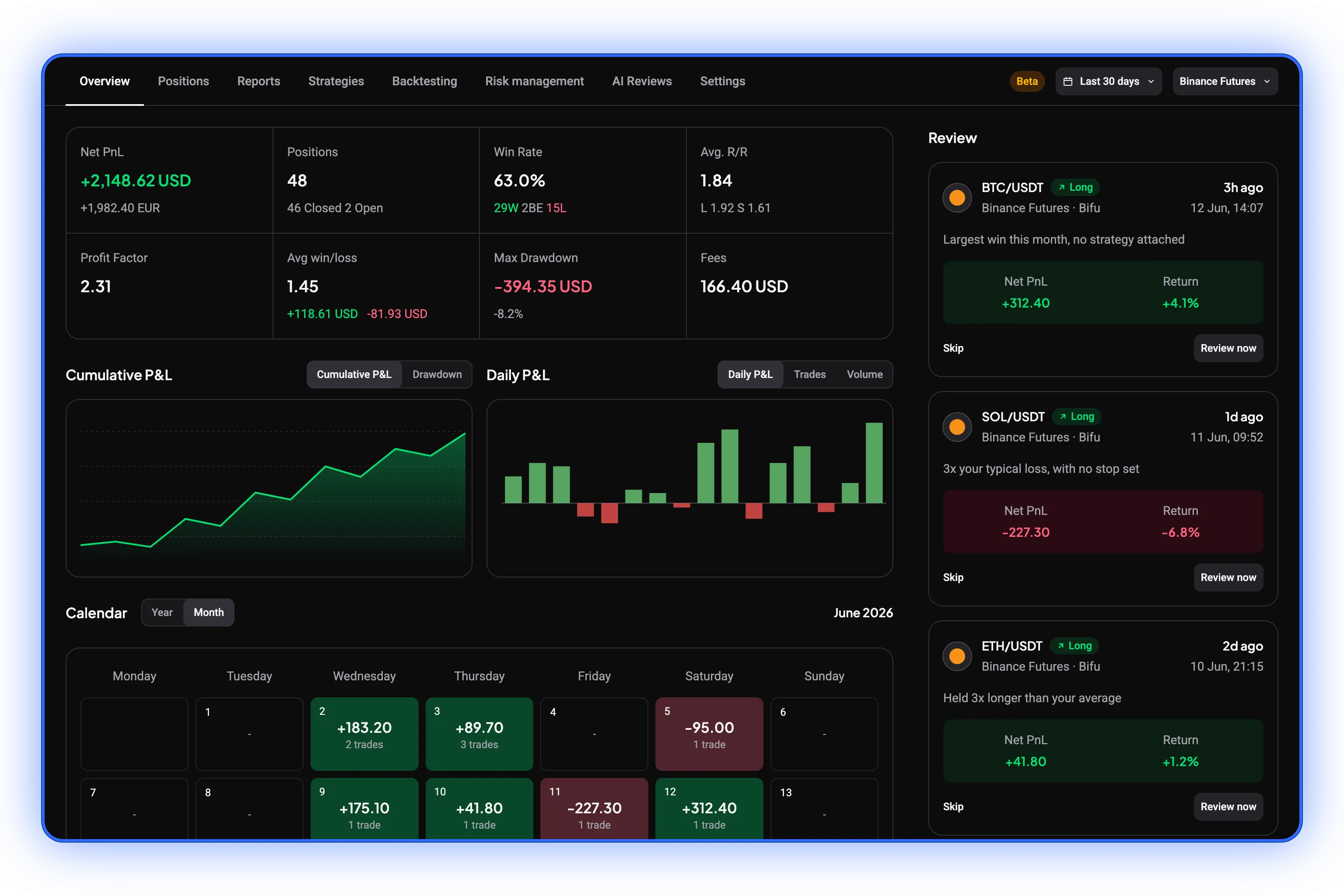






Your Trading History Becomes Your Journal
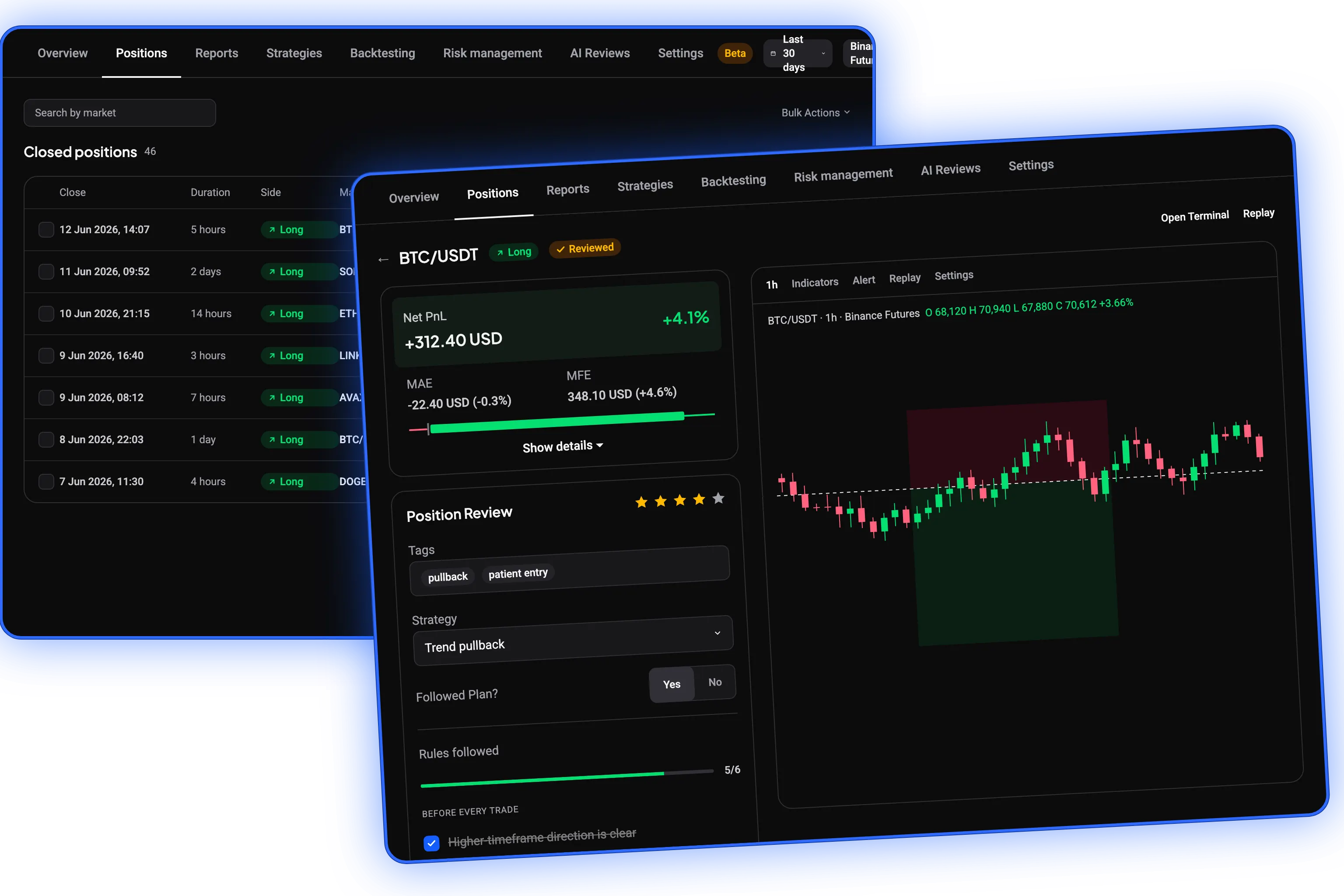
Altrady records the mechanics of every closed position (entry, exit, size, duration, fees and result) across the exchanges you connect, so you are not rebuilding your trading history in a spreadsheet. Then you add the part no report can infer: how well you executed, which plan you were following, and what you want to remember next time. PnL says whether a trade won; this is what says whether it was well taken.
- Captured for you.
- Closed positions arrive with the trade mechanics already filled in, so the record starts complete rather than empty.
- What is a trading journal?
- Rate it, tag it, explain it.
- A one-to-five rating for execution, free-form tags including the uncomfortable ones, the strategy you followed, and a note to your future self.
- Learn how to review, rate and tag trades
- Score the plan you actually followed.
- With a strategy attached, its checklist appears inline so you can tick what you stuck to. Unticked items are information, not a failing grade.
- Reviewed is what makes reports real.
- Your statistics are built from positions you have marked reviewed, so they reflect trades you have actually looked at. Review in bulk, or let a signal bot mark its own.
- Fix missing or incorrect trade history
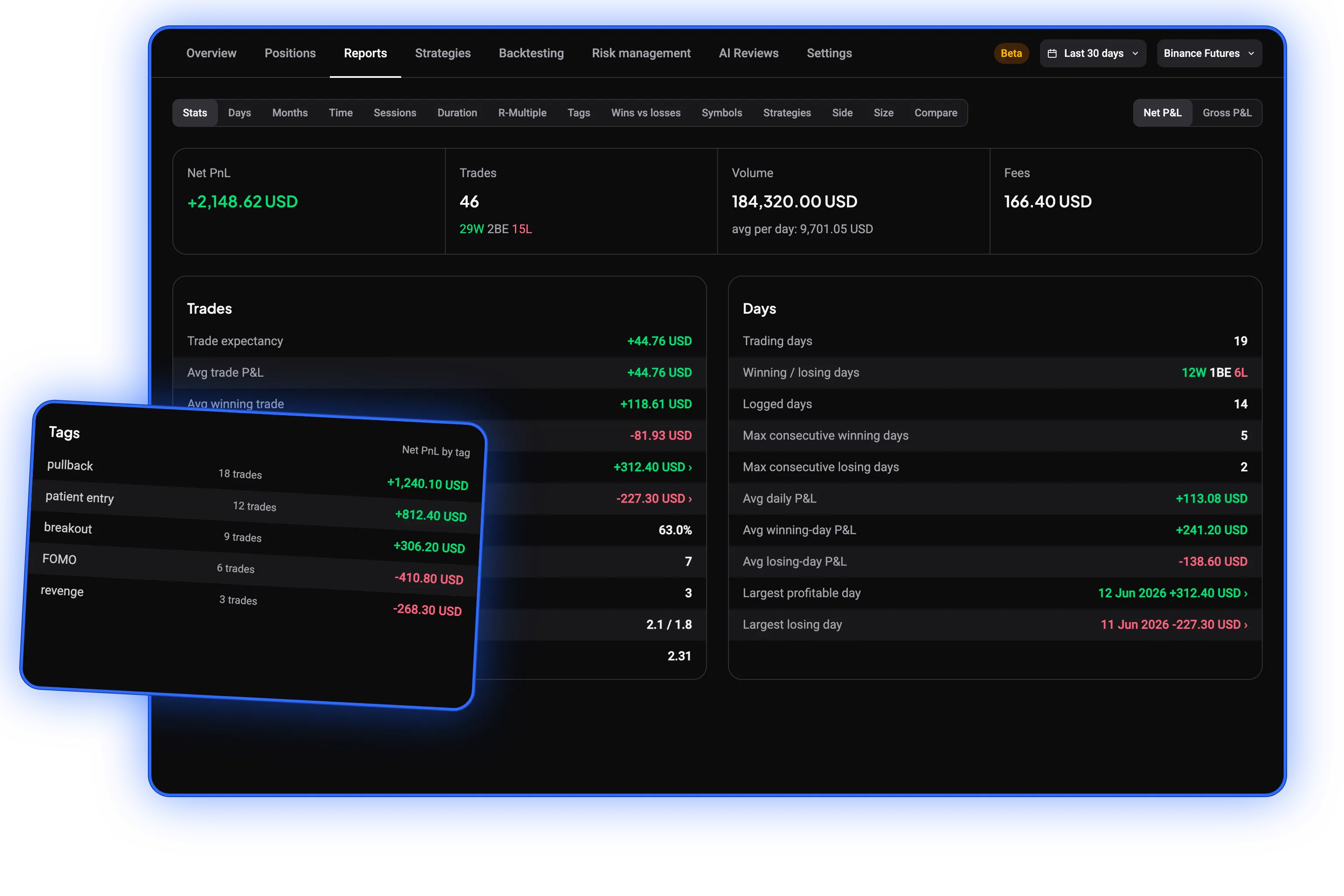
Know the Numbers Behind Your Trading
Total profit is the score, not the explanation. Your closed trades become the figures that say how the result was produced: net PnL after fees, win rate, trade expectancy, profit factor, the balance between your average win and average loss, maximum drawdown. Then they break that result apart so you can see where it actually came from.
- The shape of your results.
- Winning and losing streaks, hold times, fees, per-day and monthly figures, and cumulative and daily PnL over any period you choose.
- Learn how to read your Journal reports
- Find where you make money, and where you lose it.
- The same trades sliced one dimension at a time: market, long versus short, session and time of day, duration, tags, R-multiple, strategy and position size, each with its best and least performing groups called out.
- Learn how to find where you make and lose money
- Honest about what it can calculate.
- Planned and realized reward-to-risk come from a stored stop loss, so they fill in for smart positions created in Altrady rather than trades synced or imported from an exchange.
- Learn how to read your trading stats
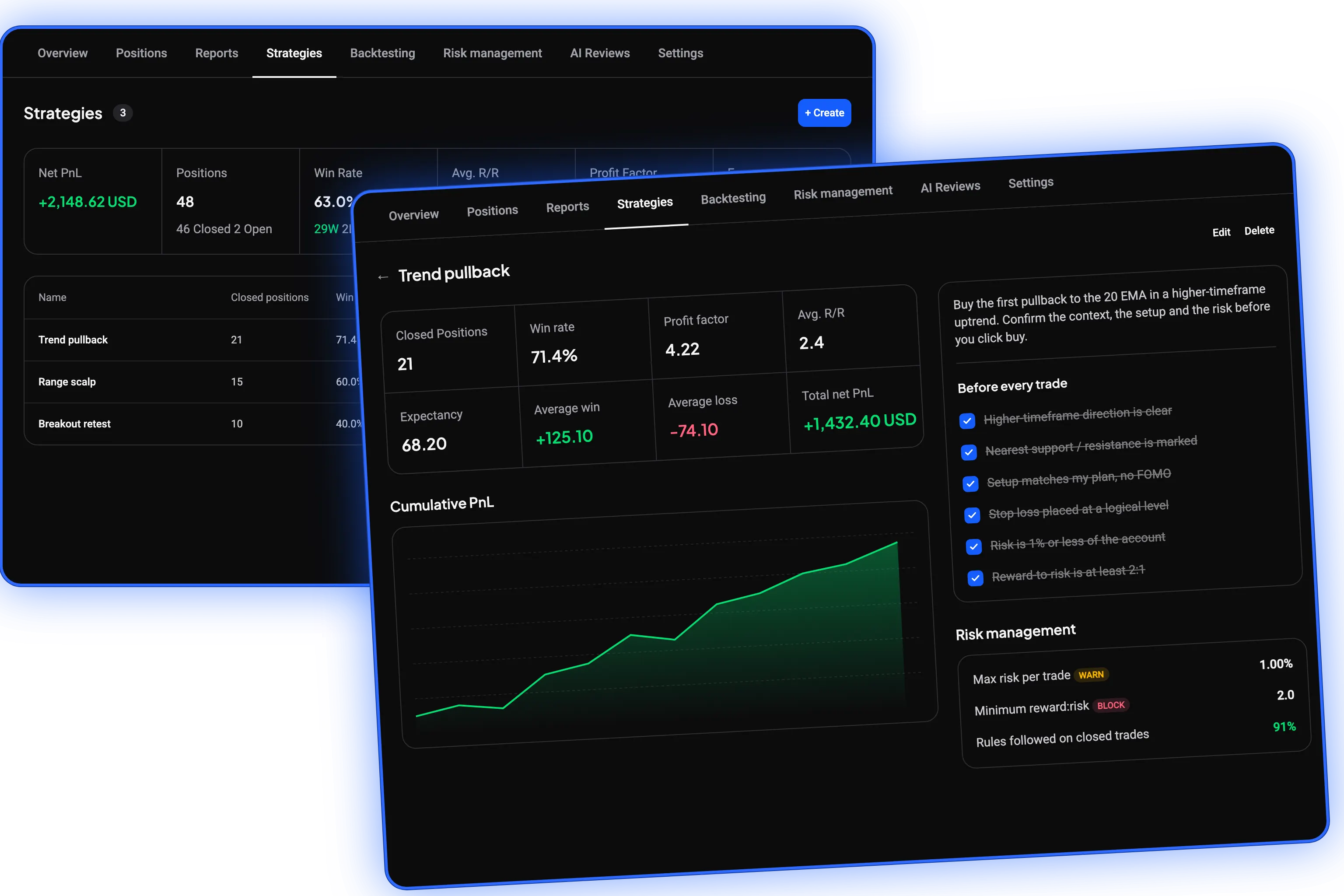
Turn Your Trading Plan Into Something Measurable
A strategy in Altrady is not just a label on a trade. It is a saved plan: a name, a trading style, a checklist of the rules you want to follow, and the risk settings you want it traded by. Attach it to your positions and you stop relying on memory to decide whether a setup works.
- A checklist you use before you enter.
- Attach a strategy to an order and its checklist appears in the trading widget, so you run through your conditions in advance rather than grading yourself afterwards.
- Start from a template or a blank page.
- More than a dozen ready-made strategies grouped by style, each a starting configuration you edit, not trading advice.
- Performance and discipline per strategy.
- Closed positions, win rate, profit factor, expectancy and net PnL for every strategy you run, next to how closely you actually followed it.
- Learn how trading strategies work
Trade Inside Your Own Risk Limits
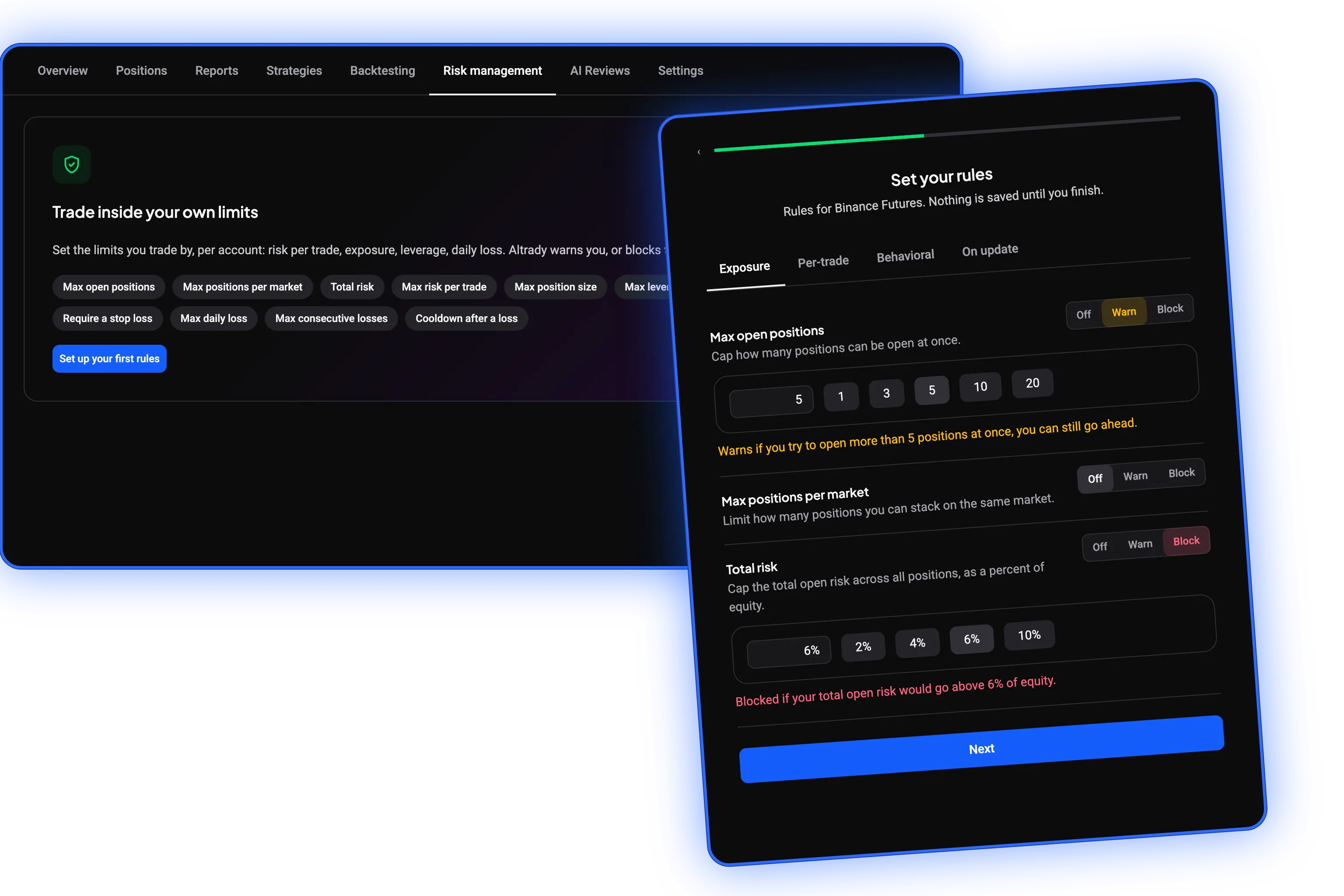
A profitable trade can still be a bad trade if you broke your own rules to get there. Altrady lets you write those rules down per account and decide what should happen when an order crosses one: nothing, a warning, or a block. The check runs inside Altrady before the order reaches the exchange.
- Off, Warn or Block: your choice per rule.
- Warn lets the order through and flags it. Block holds it until you bring the order back inside the limit, or consciously override.
- Learn how risk rules work
- Limits that match how people actually lose money.
- Exposure and total open risk, risk and size per trade, leverage, reward-to-risk, stop-loss requirements, a daily loss cap, consecutive losses and a cooldown after a loss.
- Why risk management matters
- Overrides stay on the record.
- Ignoring a rule is allowed, and it is logged in your journal, so a review can ask whether the trade was good, not only whether it won.
- See how Altrady enforces risk rules
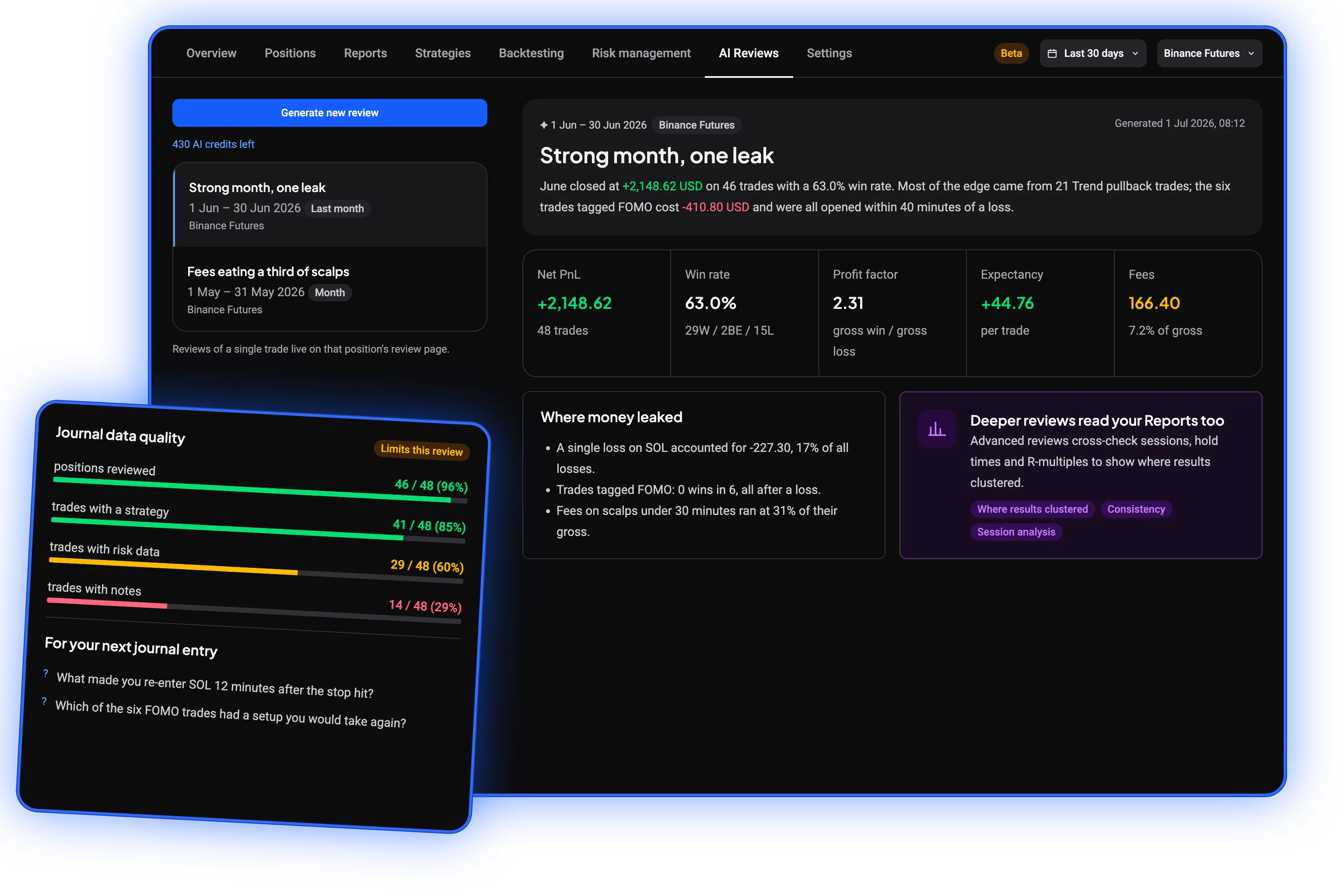
A Trading Coach That Has Read Every Trade You Made
Pick a week, a month or a single closed position and get a straight answer on what worked, where the money leaked and what to change next. An AI Review reads the trades in your own journal (your positions, tags, notes and checklist answers) and writes up what it finds. It analyzes your own past trading, not the market.
- A period, or a single trade.
- Review a day, week, month or year from the AI Reviews tab, or one closed position from its own review page.
- Result, leaks, behaviour, consistency.
- Where your results clustered, what drained them (outlier dependence, the largest loss, fee drag) and what your notes, tags and rules say about how you traded.
- It tells you when your data is thin.
- A data-quality card shows what could not be analyzed and why, so the review never pretends missing information exists. Fill in the gaps and the next one gets sharper.
- Learn how AI Trade Reviews work
- Questions for your next entry.
- Every review ends with questions written for your specific trades, ready to be answered in the journal rather than read once.
Turn Every Review Into a Better Next Trade
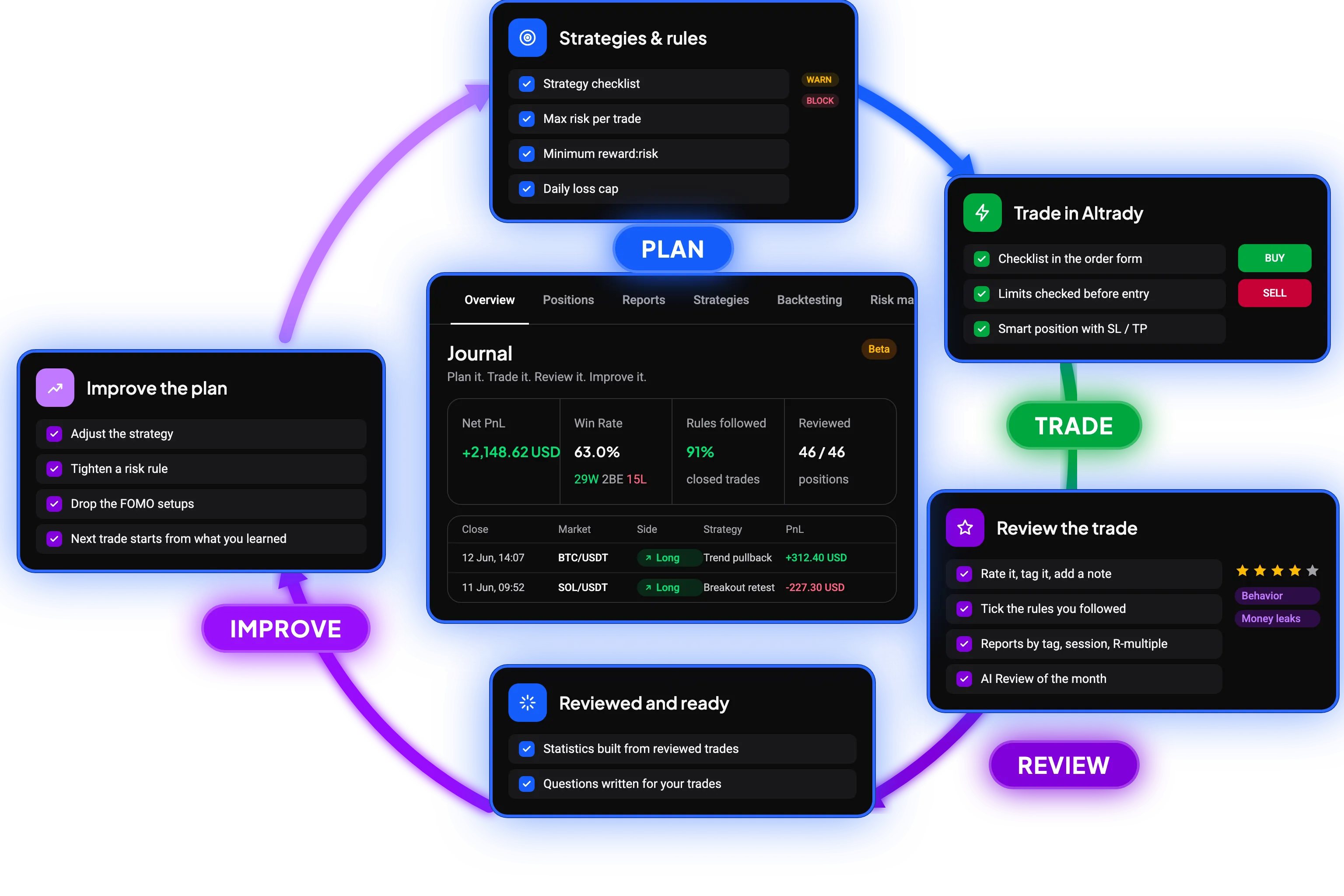
A journal that only stores the past is an archive. The point of reviewing is what you do differently on the next trade, which is why the plan, the execution, the review and the change all live in one place.
- Plan.
- Write the strategy, the checklist and the risk rules you intend to trade by.
- Trade.
- Execute and manage the position in Altrady, with your checklist and limits in front of you.
- Review.
- Rate it, tag it, read the reports, and let an AI Review look for what you missed.
- Improve.
- Adjust the plan, the rules or the behaviour, then the next trade starts from what you learned.
Your Trading Journal Is Already Connected to Your Trading
Altrady is multi-exchange crypto trading software. Because the journal sits in the same workspace where you place and manage trades, reviewing is part of the workflow rather than a separate habit you have to keep up.
- One journal, every connected exchange.
- Altrady connects to supported cryptocurrency exchanges through API keys, so closed positions from the accounts you connect land in the same journal and the same reports.
- Your funds stay where they are.
- Altrady is trading software, not an exchange or a wallet. Your funds remain on the exchanges you connect, and withdrawal permissions are never required.
- Built on the rest of the platform.
- Positions come from the same place you manage your portfolio, practise in paper trading and run backtests.
- Explore the crypto portfolio tracker
- Review where you trade.
- No exports, no second tool, no copying fills into a spreadsheet at the end of the week.
Trusted by crypto portfolio managers

I've been using Altrady for quite a while. The asset management, portfolio manager, and filtering tool are very useful for managing multiple positions across exchanges.
Founder of THE BIRB NEST
Adrian Zdunczyk
I've been using Altrady for quite a while. The asset management, portfolio manager, and filtering tool are very useful for managing multiple positions across exchanges.
Founder of THE BIRB NEST
Adrian Zdunczyk
Frequently asked questions
-
A crypto trading journal is a record of the trades you took and the thinking behind them: what you bought or sold, when, at what size, with what stop and target, and why. Kept consistently, it turns a run of wins and losses into something you can learn from, because patterns you cannot feel across three trades become obvious across fifty.
-
Altrady records the mechanics of your closed positions from the exchanges you connect, then you add the context: a one-to-five rating, tags, the strategy you followed and a note. Once a position is marked reviewed it feeds your statistics, breakdown reports, strategy performance and AI Reviews.
-
The trade mechanics are captured for you (entry, exit, size, duration, fees and result), so you are not retyping your history. Marking a position reviewed is what pulls it into your reports, and you can do that one at a time, in bulk, or have a signal bot mark its own closed positions as they close.
-
An AI Review reads the closed positions in your journal and writes up what went well, where money leaked, how your process looked and what to record next time. You can review a period (a day, week, month or year) or a single closed trade. It analyzes your own past trading data and is not investment advice, a signal or a prediction.
-
Net PnL after fees, number of positions, win rate, trade expectancy, profit factor, your average win against your average loss, maximum drawdown, winning and losing streaks, hold times, volume and fees, plus cumulative and daily PnL charts. Reward-to-risk figures are calculated from a stored stop loss, so they apply to smart positions created in Altrady rather than trades imported or synced from an exchange.
-
Yes. Breakdown reports slice the same closed trades one dimension at a time (by market, side, session, time of day, duration, tag, R-multiple, strategy and position size), with best and least performing callouts for each, so you can see where a result actually came from.
-
Yes. Every closed position has a review page with a one-to-five star rating, free-form tags (including ready-made ones like FOMO, Moved stop or Early exit), a strategy dropdown, an inline checklist of the rules you meant to follow, and a notes field.
-
Yes. A strategy is a saved plan with a name, trading style, a checklist of your rules and its own risk settings. You can start from a blank strategy or one of more than a dozen templates, attach it to positions, tick the checklist before you enter from the trading widget, and compare how each strategy performs. How many strategies you can keep depends on your plan.
-
You set limits per account (risk and size per trade, leverage, total exposure, reward-to-risk, stop-loss requirements, a daily loss cap, consecutive losses and a cooldown after a loss) and choose Off, Warn or Block for each. Altrady checks every order against them before it reaches the exchange. Overrides are allowed and are recorded in your journal. Risk rules are a Premium feature.
-
Yes. Altrady connects to supported cryptocurrency exchanges through API keys, so closed positions from the accounts you connect come into the same journal and the same reports. Altrady is trading software rather than an exchange or wallet: your funds stay on the exchanges you connect and withdrawal permissions are never required.
The Journal comes with your Altrady plan
Journal reports are included from the Essential plan up. Account-level risk rules are part of Premium, and AI Reviews use AI credits from your monthly allowance. Compare what each plan includes on the pricing page.
Explore All Features
Discover more tools to enhance your trading.
 Trade Automation
 Grid Bot
 DCA Bot
 HODL Bot
 TradingView Bot
 Signal Bot
 Webhook Bot
 Smart Trading
 Multi Exchange
 Quick Scanner
 Base Scanner
TA Screener
Base Scanner
TA Screener
 Portfolio
 Positions & PnL
 Paper Trading
 Backtesting
 Watchlists & Alerts
Multi-Charts
Watchlists & Alerts
Multi-Charts
 Trading Presets
 Risk Calculator
 Market Explorer
 Crypto Journal
Start reviewing the trades you already made
Connect an exchange and your closed positions become a journal you can learn from. 5 days free, no credit card required.