

ICT trading is a price-action method created by Michael J. Huddleston, the Inner Circle Trader. It reads charts through liquidity, market structure and institutional order flow, using tools such as fair value gaps, order blocks, premium and discount zones, optimal trade entry and time windows called killzones. It uses no indicators.
ICT has a large vocabulary, which is why it can feel confusing at first. This guide explains the core ICT concepts in plain terms, walks through a typical ICT trading model step by step, looks honestly at whether it works, and shows how to apply it to crypto. It describes how traders use the method and is not trading advice.
Key Takeaways
- ICT is a full method, not a single setup. It combines market structure, liquidity, reaction zones and timing into rule-based models.
- Liquidity comes first. ICT expects price to run the stops above highs or below lows before the real move.
- Entries happen at specific zones. Fair value gaps, order blocks and the 62% to 79% optimal trade entry zone.
- Timing matters in ICT. Killzones and models such as the silver bullet limit when a setup is valid.
- Results depend on the trader. ICT is discretionary and its claims are not independently tested, so test it on paper first.
What Is ICT Trading?
ICT stands for Inner Circle Trader, the name Michael J. Huddleston teaches under. His method assumes that large institutions need liquidity to fill big orders, and that the market moves to collect that liquidity, usually the stop-loss and pending orders resting above swing highs and below swing lows. ICT traders try to read where that liquidity sits, wait for price to take it, and enter when structure shifts in the other direction.
Smart Money Concepts (SMC) is a simpler framework built largely from ICT ideas. If you are deciding between the two, read ICT vs SMC.
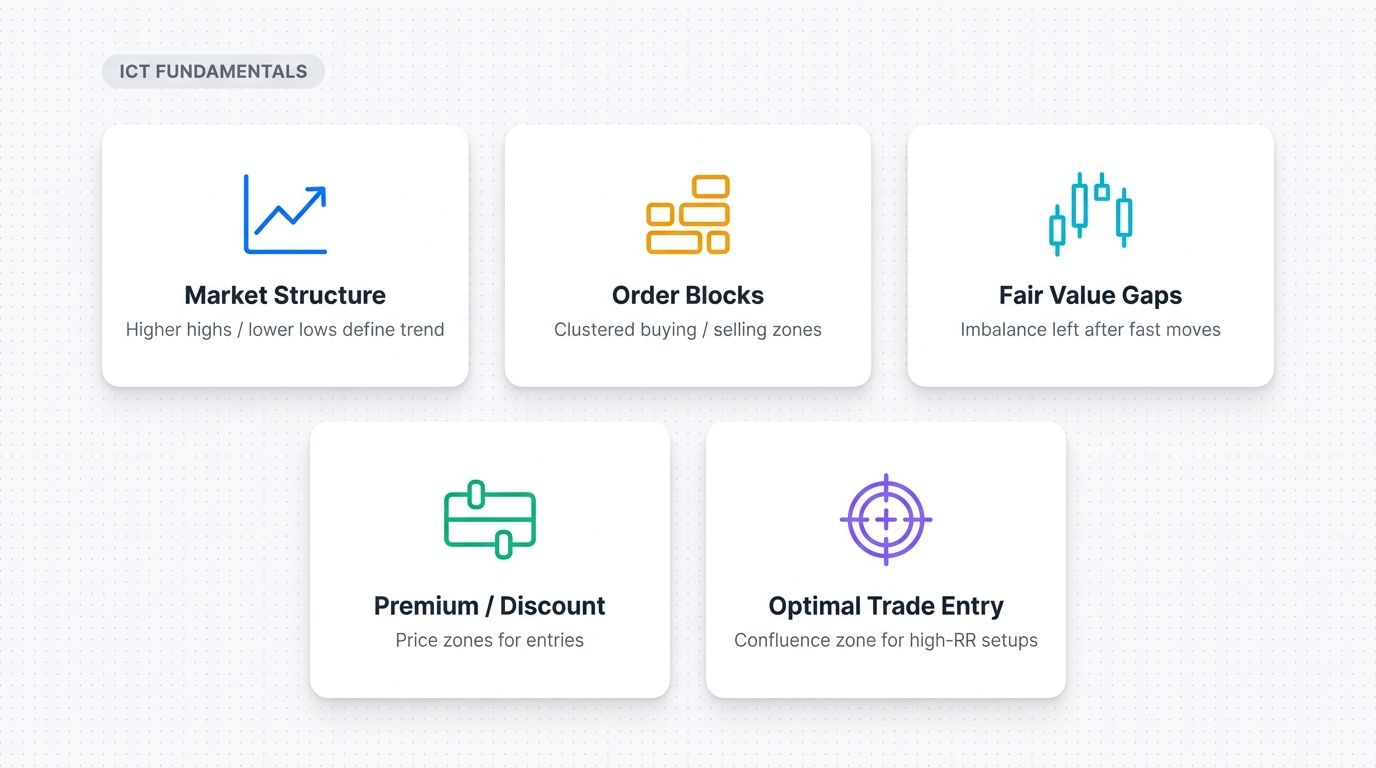
Core ICT Concepts
Market structure
Higher highs and higher lows define an uptrend; lower highs and lower lows define a downtrend. A break in the direction of the trend confirms it, and a market structure shift (MSS), the first break against the trend, hints at a reversal. See how to identify swing highs and lows.
Liquidity: buy-side and sell-side
Buy-side liquidity (BSL) rests above swing highs and equal highs, where short sellers keep their stops. Sell-side liquidity (SSL) rests below swing lows and equal lows. ICT expects price to run one side before moving in the opposite direction. See sell-side liquidity and liquidity sweeps.
Fair value gap (FVG)
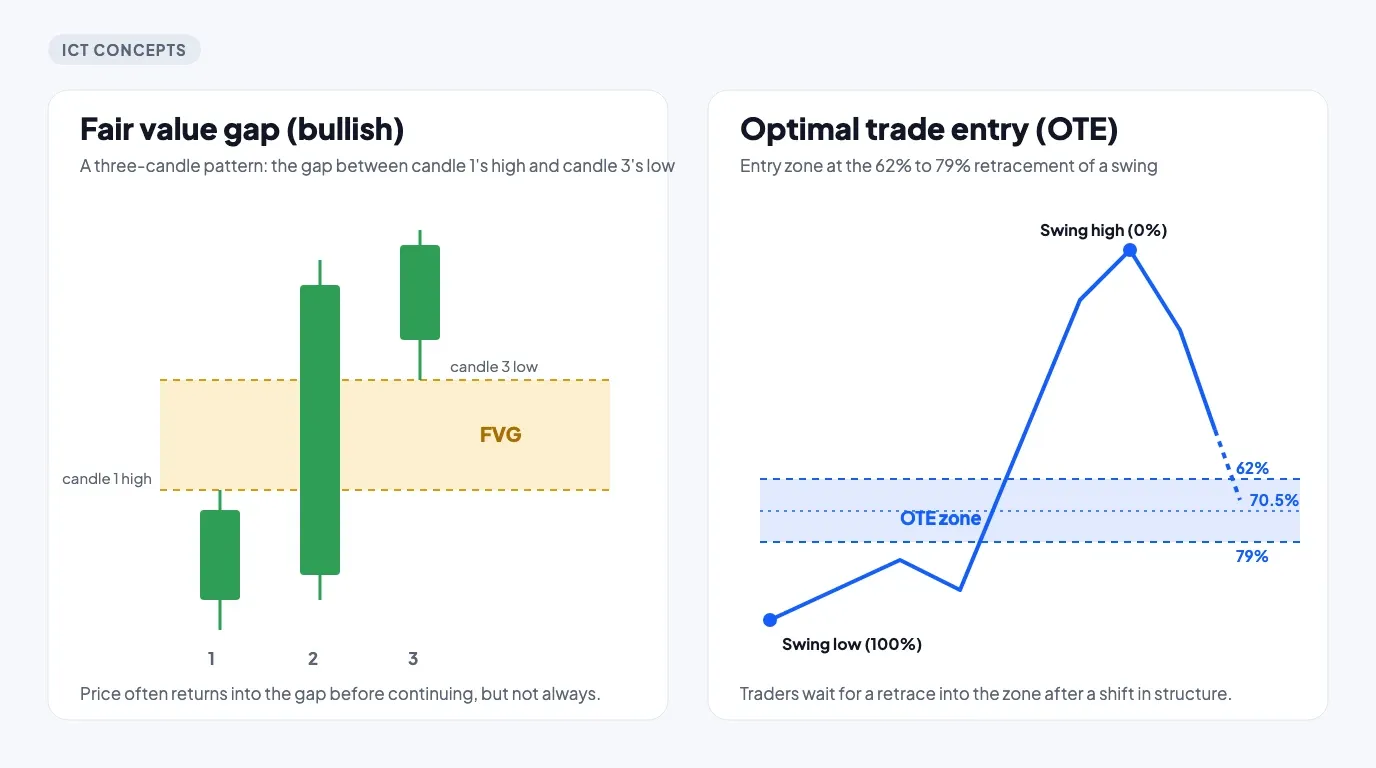
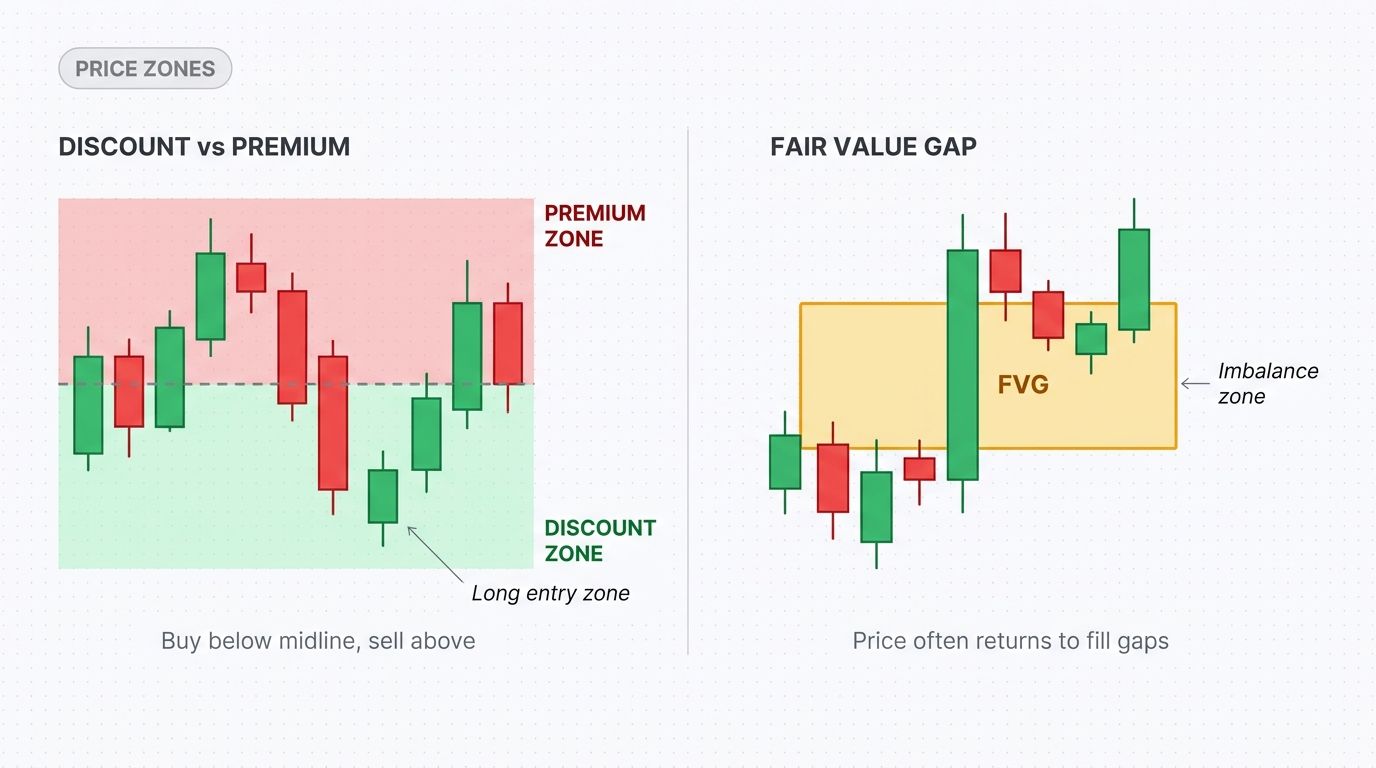
A fair value gap is a three-candle pattern where a strong middle candle leaves a gap between the first candle's high and the third candle's low (or the reverse in a bearish move). ICT treats it as an imbalance that price often returns to before continuing. See our guide to fair value gaps.
Order block
An order block is the last opposite-colour candle before a strong move that breaks structure, for example the last down candle before a sharp rally. ICT uses it as a zone where price may react on a return. See bearish order blocks.
Premium and discount
Split the current range at its 50% level. Above it is premium, below it is discount. ICT prefers buying in discount and selling in premium.
Optimal trade entry (OTE)
OTE is the zone between the 62% and 79% Fibonacci retracement of a swing, with 70.5% as the level many ICT traders watch. After a shift in structure, traders wait for price to retrace into this zone, ideally where it overlaps a fair value gap or order block.
Killzones
Killzones are session windows when ICT expects the most meaningful moves, mainly the London open and the New York open, measured in New York time. Setups outside these windows are treated as lower quality.
Power of three
ICT describes each day or week as accumulation, manipulation and distribution: price builds a range, makes a false move that takes liquidity, then moves in the real direction.
PD arrays
Premium and discount arrays are the reaction zones ICT ranks by importance, including order blocks, fair value gaps, breaker blocks and old highs and lows. See the PD array matrix.
ICT Concepts Glossary
| Term | Meaning |
|---|---|
| BSL / SSL | Buy-side and sell-side liquidity: stops above highs and below lows |
| FVG | Fair value gap: a three-candle imbalance |
| OB | Order block: last opposite candle before a strong move |
| MSS | Market structure shift: first break against the trend |
| OTE | Optimal trade entry: 62% to 79% retracement zone |
| PD array | Premium and discount array: ranked reaction zones |
| Killzone | Session window for higher-quality setups |
| Silver bullet | A time-based model that enters on a fair value gap inside a set one-hour window |
| AMD / Power of three | Accumulation, manipulation, distribution |
An ICT Trading Strategy Step by Step
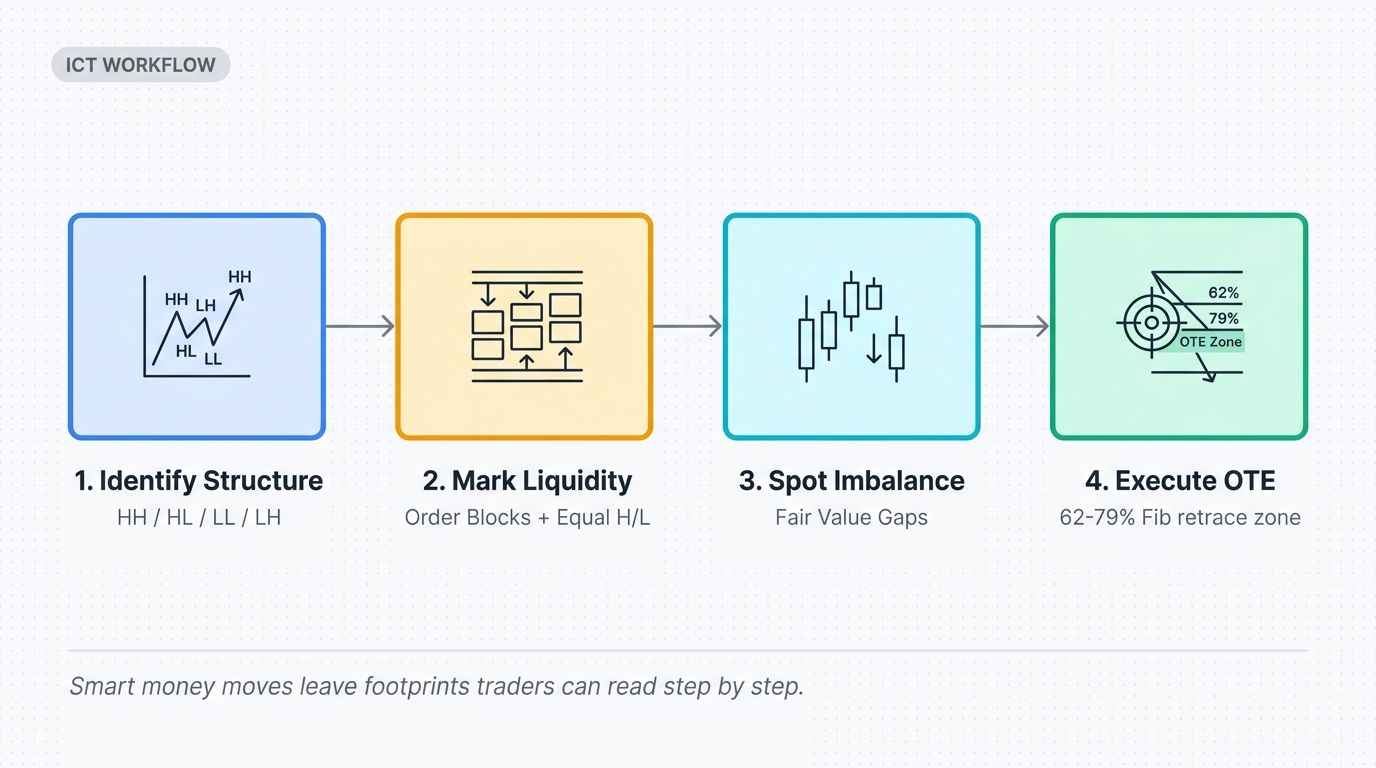
ICT teaches several models, but most follow the same sequence.
- Set the bias on a higher timeframe. Use the daily or 4-hour chart to decide whether price is likely to seek buy-side or sell-side liquidity next.
- Mark the liquidity. Note the obvious swing highs, swing lows and equal highs or lows where stops cluster.
- Wait for the sweep. Let price run the liquidity against your bias, for example dipping below a recent low in a bullish market.
- Look for a market structure shift. On a lower timeframe, wait for price to break the last swing in your direction with a strong move that leaves a fair value gap.
- Enter on the retrace. Place the entry where the fair value gap or order block overlaps the OTE zone, preferably inside a killzone.
- Set the stop and target. Put the stop beyond the swept low or high, and target the opposite liquidity, such as the next swing high.
For a pullback setup that combines ICT entries with SMC structure, see combining ICT and SMC.
Does ICT Trading Work?
ICT is popular, and many traders find its framework useful for reading charts. It also has fair criticism:
- Many ideas are renamed classics. Liquidity runs, order blocks and fair value gaps overlap with stop hunts, supply and demand zones and price gaps that traders used long before ICT.
- It is discretionary. Two traders can mark different swings, gaps and blocks on the same chart, so results vary widely.
- Hindsight makes it look better. Examples are usually chosen after the move; live setups are less clean.
- Its claims are not independently tested. There is no published, audited record showing the method beats the market.
The practical answer: treat ICT as a framework for reading structure and liquidity, define exact rules for your own version, and test them on paper over enough trades to judge them. Past or simulated results do not guarantee future results. We look at the most common pitfalls in why most ICT traders fail.
ICT Trading in Crypto
- Killzones are less clear-cut. They come from forex sessions, but crypto trades 24/7. Session opens still bring volume, so test whether a time filter helps on your pair.
- Sweeps can run further. Crypto volatility means stops just beyond a swing are hit more often. Leave room and size positions to match.
- Stick to liquid pairs. Structure, gaps and order blocks are cleaner on BTC and ETH than on thin altcoins.
- Watch leverage. A correct read with too much leverage can still be liquidated during a sweep.
Use ICT Concepts in Altrady
Altrady's Smart Money indicator marks market structure from a higher timeframe directly on your chart: swing points, buy-side and sell-side liquidity, fair value gaps and the OTE zone. Add it from Indicator in the chart toolbar. You can then place the entry, stop loss and take profits in one smart order, set price alerts on the levels you marked, and practise your ICT model on a paper trading account before using real funds.
Frequently Asked Questions
What is ICT trading?
ICT trading is a price-action method created by Michael J. Huddleston, the Inner Circle Trader. It reads charts through liquidity, market structure and institutional order flow, using fair value gaps, order blocks, the optimal trade entry zone and killzones, without indicators.
What does ICT stand for in trading?
ICT stands for Inner Circle Trader, the name under which Michael J. Huddleston teaches his trading concepts. In other fields ICT usually means information and communication technology, which is unrelated.
What are the main ICT concepts?
The core concepts are market structure, buy-side and sell-side liquidity, fair value gaps, order blocks, premium and discount, optimal trade entry, killzones and the power of three. Most ICT models combine a liquidity sweep, a market structure shift and an entry at a gap or order block.
What is the ICT silver bullet?
The silver bullet is a time-based ICT model that looks for an entry on a fair value gap inside a specific one-hour window, such as 10:00 to 11:00 New York time. It combines ICT's liquidity and gap ideas with a strict time filter.
What is OTE in ICT?
OTE, or optimal trade entry, is the zone between the 62% and 79% Fibonacci retracement of a swing, with 70.5% as a key level. ICT traders wait for price to retrace into it after a shift in structure.
Does ICT trading work for crypto?
Traders apply ICT to crypto, especially liquid pairs like BTC and ETH. Because crypto trades 24/7 and moves fast, killzones are less defined and stops need more room, so test your model on paper first.
Is ICT trading good for beginners?
ICT can teach beginners to think about liquidity and structure, but its many terms and models take time to learn. Starting with market structure and liquidity, then adding one entry model, is easier than learning everything at once.
Is ICT the same as SMC?
No. Smart Money Concepts is a simpler framework built largely from ICT ideas. ICT adds stricter rules, timing and named models. See our full comparison of ICT vs SMC.