
ETH staking means locking ether to help validate the Ethereum network in return for rewards, currently around 2.5% a year before fees according to ethereum.org (October 2026). You can run your own validator with 32 ETH, use a pool or liquid staking protocol from 0.01 ETH, or stake through an exchange.
Each route trades rewards against control, effort and risk. This guide explains how Ethereum staking works, what each method pays today, what solo staking actually requires since the Pectra and Fusaka upgrades, the risks, and how long it takes to get your ETH back. Rates and queue times below were checked on 21 October 2026 and change daily. Nothing here is financial or tax advice.
Key Takeaways
- Rewards are lower than many older guides say. The network rate is about 2.5% a year before fees; after fees, Lido showed 2.2%, Rocket Pool 1.86% and Coinbase 1.64%.
- Solo staking keeps every reward but asks the most of you. You need 32 ETH, a dedicated machine with a large NVMe drive, a reliable connection and the time to keep it running.
- You can run a validator with less than 32 ETH. Rocket Pool needs a 4 ETH bond per validator and Lido's Community Staking Module 2.4 ETH for the first key.
- Getting in currently takes longer than getting out. The validator entry queue was about 23.5 days and the exit queue about 3.5 days on 21 October 2026.
- Staking does not protect you from price moves. Rewards are paid in ETH, so a fall in the ETH price can outweigh a year of rewards.
What Is Ethereum Staking?
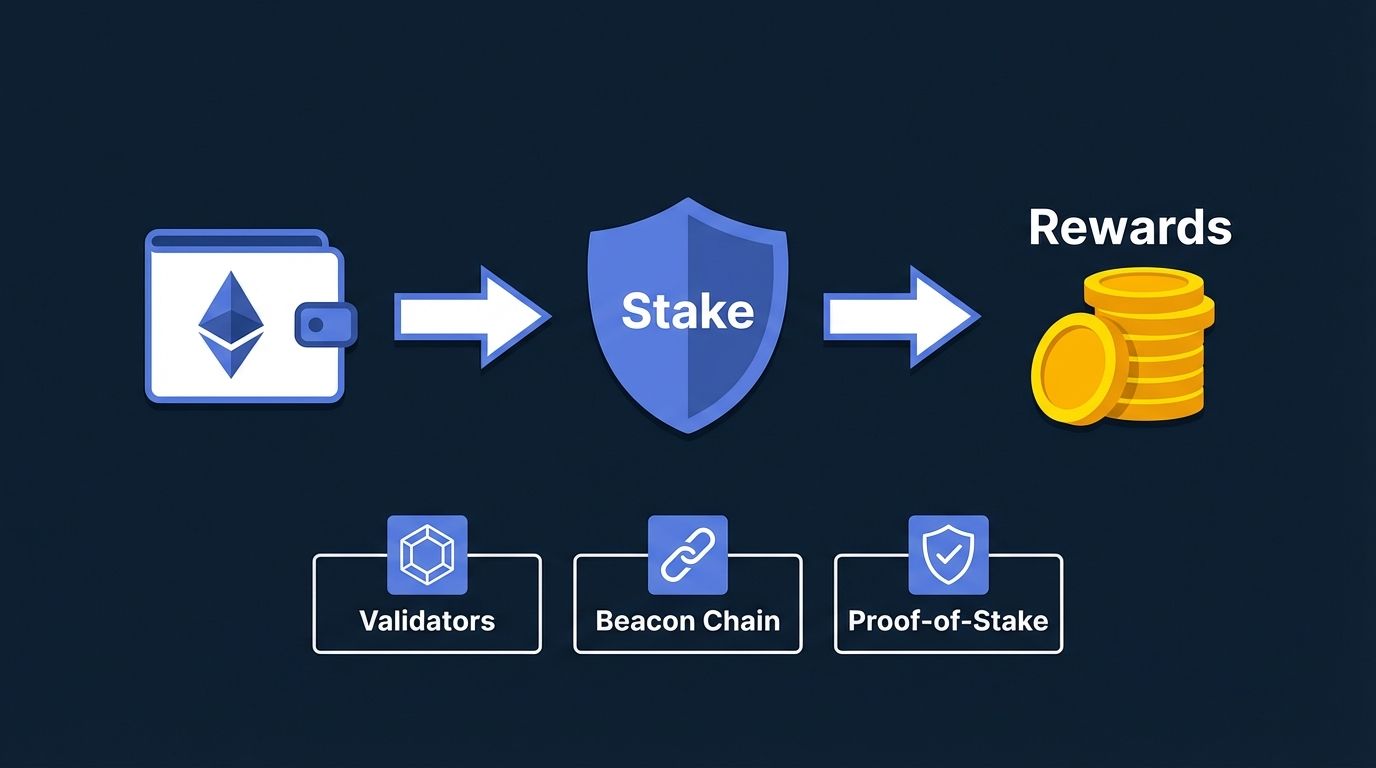
Ethereum staking is the process of locking ETH as collateral so the network can use it to validate transactions under proof of stake. Since the Merge in September 2022, Ethereum no longer relies on mining. Validators are chosen to propose and attest to new blocks, earn rewards when they do this correctly, and lose part of their stake when they break the rules.
- Validators run the software that proposes and attests to blocks.
- Stakers are either validators themselves or people who deposit ETH with a pool, protocol or exchange that runs validators for them.
- The Beacon Chain is the consensus layer that tracks validators, their balances and their rewards.
Staking does two jobs at once: the locked ETH makes attacks expensive, and the rewards pay holders for providing that security.
How ETH Staking Works
Each validator needs at least 32 ETH. Since the Pectra upgrade on 7 May 2025, a single validator can hold up to 2,048 ETH, so large stakers no longer need to run thousands of separate 32 ETH validators. Validators earn rewards for attesting to blocks and for proposing them, and they also receive priority fees and MEV (maximal extractable value) when they propose a block.
There are four main ways to take part:
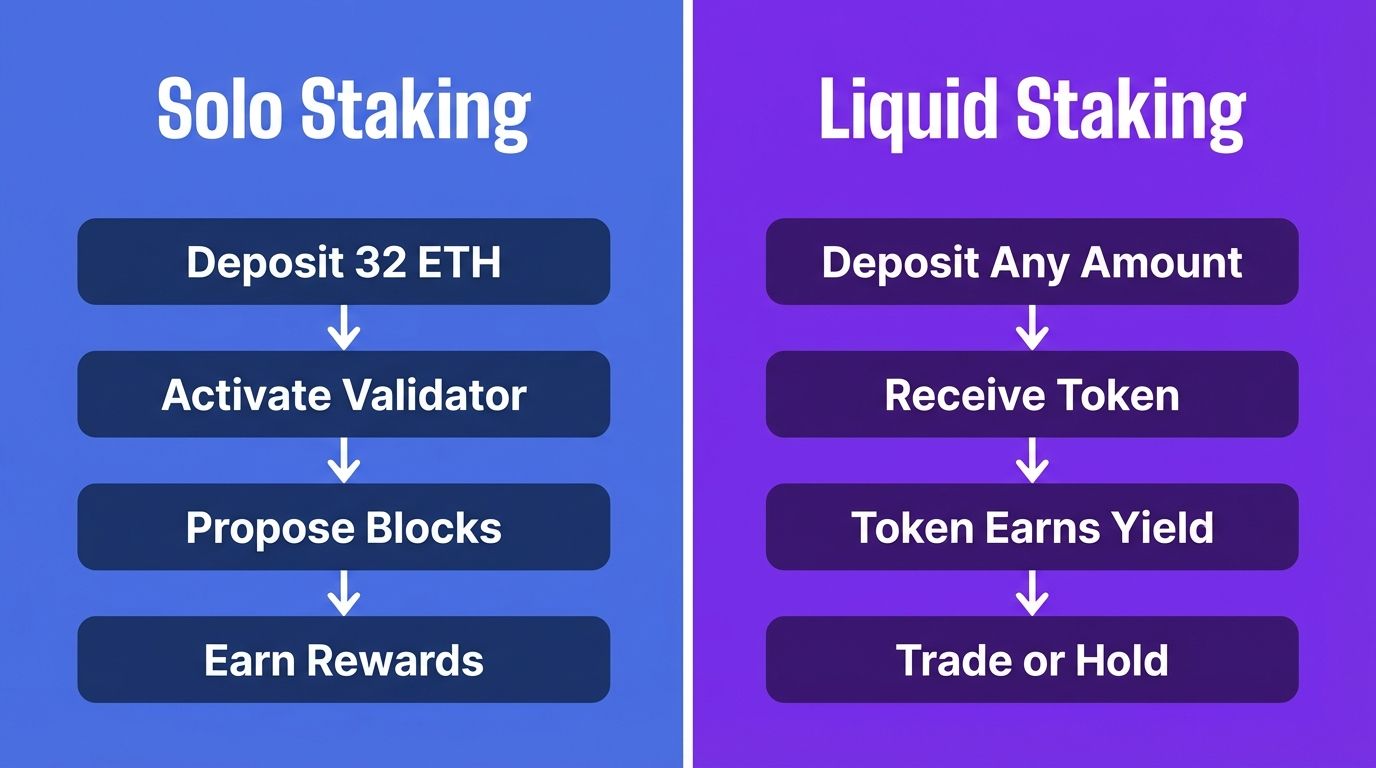
- Solo staking: you run your own validator with your own 32 ETH or more and keep all the rewards.
- Staking as a service: you deposit your own 32 ETH but a provider runs the node for you.
- Liquid and pooled staking: you deposit any amount with a protocol such as Lido or Rocket Pool and receive a token (stETH, rETH) that represents your ETH plus rewards and can be traded or used in DeFi.
- Exchange staking: an exchange such as Coinbase or Kraken stakes your ETH for you and keeps part of the rewards.
ETH Staking Rewards in 2026
The staking rate is not fixed. It falls as more ETH is staked, because the same issuance is shared among more validators, and it rises a little when network activity brings in more fees and MEV. On 21 October 2026 about 44 million ETH, roughly 36% of supply, was staked.
| Method | Rate shown | What it means | Source |
|---|---|---|---|
| Network average | About 2.5% APR | Before any provider fee | ethereum.org/staking |
| Solo staking | Close to the network rate | You keep all rewards; your result depends on uptime and proposals | ethereum.org |
| Lido (stETH) | 2.2% APR | After Lido's 10% fee, 7-day average | lido.fi |
| Rocket Pool (rETH) | 1.86% APR | After node operator commission | Rocket Pool API |
| Coinbase | 1.64% APY | After a 35% commission (lower with Coinbase One) | coinbase.com |
| Kraken (bonded) | 2.71% | Before Kraken's fee of 25% on holdings up to $1M | kraken.com |
All figures were checked on 21 October 2026. Rates change daily, and availability depends on where you live.
As a simple example, 10 ETH staked at a 2.2% net rate earns about 0.22 ETH over a year if the rate stays the same. That reward is in ETH, so its value in dollars or euros moves with the ETH price. Past rates do not guarantee future rewards.
Solo Staking Ethereum: Requirements, Setup and Costs
Solo staking, also called home staking, means running your own validator on a machine you control. It is the most decentralized way to stake and the only one where you keep every reward and every key. It also puts all the work and responsibility on you.
What you need for solo staking
- 32 ETH or more: each validator holds between 32 and 2,048 ETH.
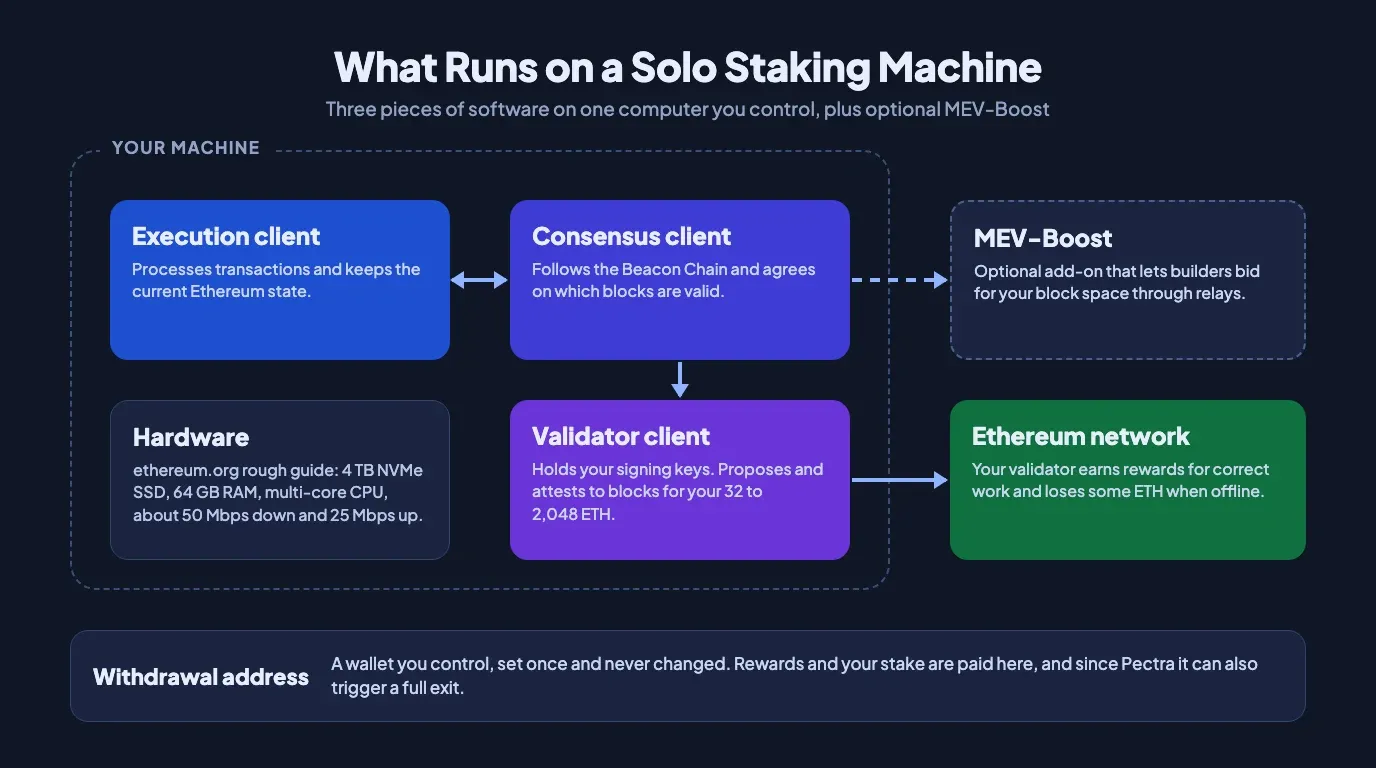
- A dedicated machine: ethereum.org's solo staking page gives a rough guide of a 4 TB NVMe SSD, 64 GB of RAM and a modern multi-core CPU. Its node guide lists a lower minimum of 16 GB RAM and a 2 TB NVMe drive, but notes that 2 TB is likely to be exceeded by 2027.
- A reliable connection: about 50 Mbps down and 25 Mbps up for a validator. Since the Fusaka upgrade in December 2025, nodes share blob data in pieces, which lowers disk and download needs but raises upload needs, especially if you build blocks locally.
- Time and attention: client updates, monitoring and fixing problems when the node goes offline.
How to set up a solo validator
- Prepare the hardware and a stable internet connection.
- Install and sync an execution client. Choosing a minority client helps the network: a bug in a client most validators use can get them slashed, while a bug in a minority client usually only causes small offline penalties.
- Install and sync a consensus client and connect it to the execution client.
- Generate your validator keys and load them into the validator client, following the official staking launchpad.
- Set your withdrawal address. It can be set only once and cannot be changed, so use a wallet you fully control.
- Deposit between 32 and 2,048 ETH to the deposit contract, then monitor your validator once it is activated.
0x01 or 0x02 withdrawal credentials
Since Pectra there are two types of withdrawal credentials. With 0x01, any balance above 32 ETH is swept to your withdrawal address automatically every few days. With 0x02, rewards compound inside the validator up to 2,048 ETH, and taking out a partial amount needs a transaction from your withdrawal address. Switching a validator from 0x01 to 0x02 cannot be undone without exiting.
MEV-Boost
MEV-Boost is optional open-source software that runs alongside your consensus client. It lets specialised block builders bid, through relays, for the right to fill the blocks your validator proposes, which can raise your rewards from proposals. If no good bid arrives, your validator still builds a block locally.
Solo staking with less than 32 ETH
- Rocket Pool: since its Saturn I upgrade went live in February 2026, node operators can run a validator with a 4 ETH bond, with the rest coming from rETH stakers.
- Lido Community Staking Module: open to anyone, with a bond of 2.4 ETH for the first validator key and 1.3 ETH for each further key.
- Squad staking with DVT: distributed validator technology such as Obol or SSV splits a validator's signing key across several operators, so a group can run a validator together and keep it online if one member drops out.
Is solo staking worth it?
Solo staking makes most sense if you already hold 32 ETH or more, are comfortable running and updating server software, and value keeping full control of your keys. If you are not, the setup and the risk of mistakes can outweigh the extra rewards compared with a liquid staking token after fees.
Risks of Ethereum Staking
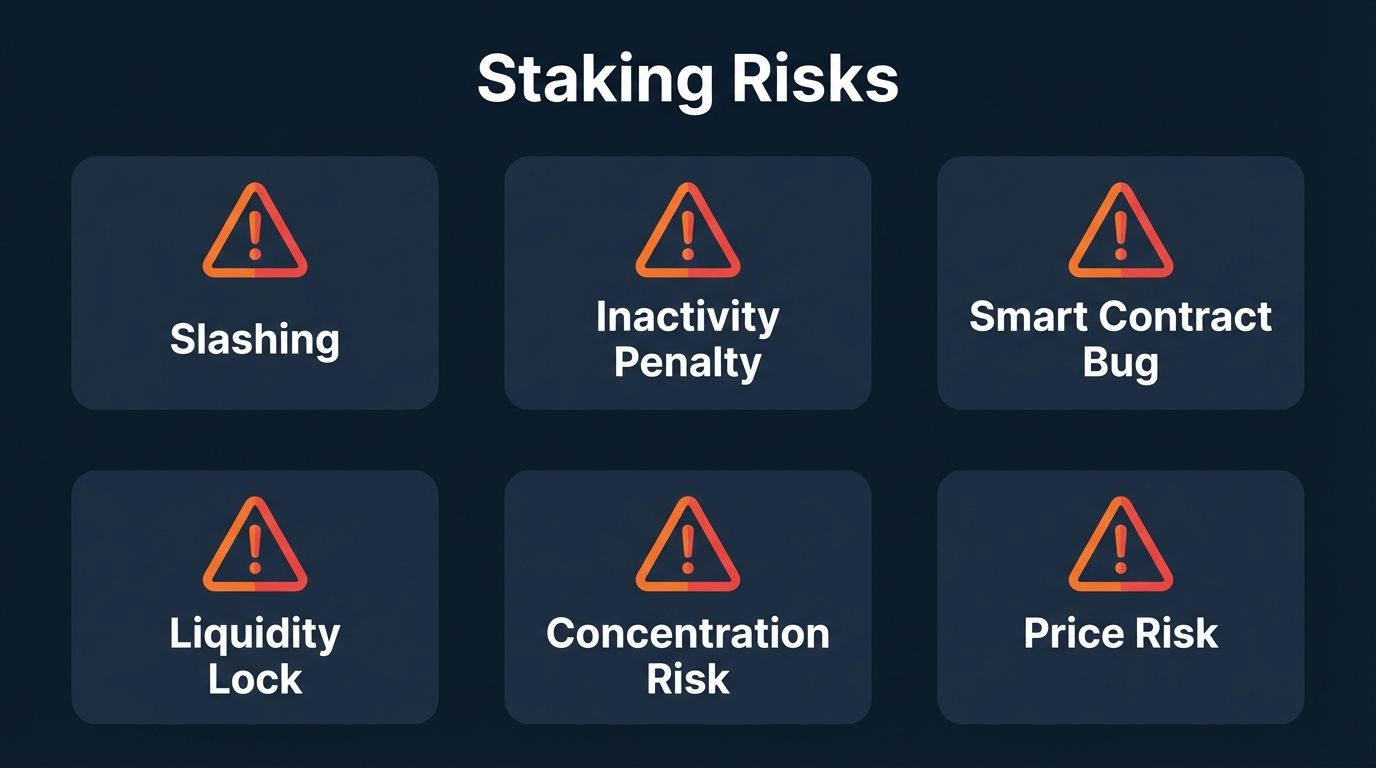
- Slashing: a validator that proposes two blocks for the same slot or signs conflicting votes is slashed. Since Pectra the initial penalty is 1/4096 of the balance, about 0.0078 ETH for 32 ETH, but an extra penalty grows with how many other validators were slashed at the same time and can reach the full balance. Most accidental slashing comes from running the same keys on two machines.
- Offline penalties: a validator that is offline loses roughly what it would have earned. If the whole network stops finalizing, an inactivity leak drains offline validators faster.
- Smart contract risk: liquid staking protocols run on smart contracts, and a bug could cost depositors money.
- Liquidity risk: native staking means waiting in entry and exit queues. Liquid staking tokens can usually be sold, but sometimes at a discount to ETH.
- Custodial and concentration risk: an exchange holds your ETH and keys, and a few large providers control a big share of staked ETH.
- Price risk: rewards are paid in ETH. A drop in the ETH price can outweigh years of staking rewards.
How Long Does It Take to Stake and Unstake ETH?
Native staking has two queues that limit how fast ETH enters and leaves the validator set. On 21 October 2026, validatorqueue.com showed:
- Entry queue: about 1.36 million ETH waiting, roughly 23.5 days.
- Exit queue: about 145,000 ETH waiting, roughly 3.5 days, plus the withdrawal sweep, which can add several more days.
Rewards above your validator's balance limit are swept to your withdrawal address automatically. A full exit can be signed with your validator key or, since Pectra, triggered by a transaction from your withdrawal address. Liquid staking tokens let you skip the queue by selling the token, at whatever price the market offers.
How to Start Staking ETH
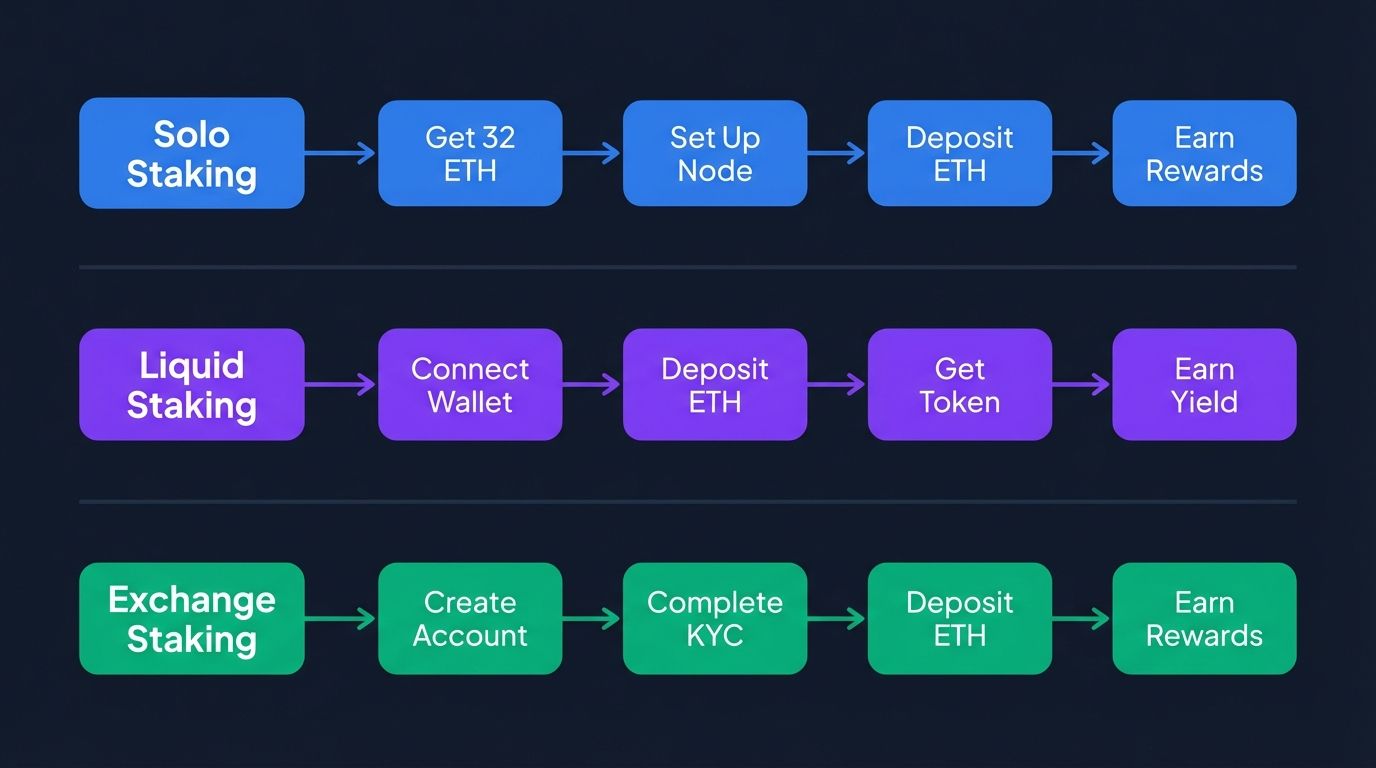
Solo staking (32 ETH or more)
- Prepare a dedicated machine and a reliable connection.
- Install and sync an execution client and a consensus client.
- Generate validator keys with the official staking launchpad and set a withdrawal address you control.
- Deposit 32 to 2,048 ETH and wait for activation in the entry queue.
- Keep the node online, updated and monitored.
Liquid staking (any amount)
- Connect a self-custody wallet to the protocol's official site.
- Deposit ETH and receive a liquid staking token such as stETH or rETH.
- Hold the token, use it in DeFi, or redeem or sell it for ETH later.
Exchange staking (easiest, least control)
- Open an account with an exchange that offers ETH staking where you live and complete verification.
- Choose the ETH staking product and check its commission and unstaking time.
- Stake your ETH; rewards are credited by the exchange.
Whichever route you choose, check that you are on the official website or contract address. Phishing sites that copy staking platforms are common, and on-chain transactions cannot be reversed.
Staking and Active Trading
Staking suits ETH you plan to hold for a long time. ETH you want to trade needs to stay liquid, and staked ETH in a native validator or an exchange's bonded product can take days to free up. Many traders keep the two separate: a long-term position that is staked, and a trading balance on their exchanges.
Altrady does not stake ETH for you. It connects to your exchange accounts so you can trade ETH across them from one terminal, track your exchange balances in one portfolio, and set price alerts on ETH while your staked position stays untouched. You can try it with a 5-day free trial.
Frequently Asked Questions
How much ETH do I need to stake?
You need 32 ETH to run your own validator, and one validator can now hold up to 2,048 ETH. Liquid staking protocols and pools accept as little as 0.01 ETH, and exchanges often have very low minimums. Rocket Pool and Lido's Community Staking Module also let you run a validator with a bond of 4 ETH or 2.4 ETH.
What is the current ETH staking APR?
ethereum.org showed a network rate of about 2.5% on 21 October 2026, before fees. After fees, Lido showed 2.2%, Rocket Pool 1.86% and Coinbase 1.64%. The rate changes daily with the amount of ETH staked and network activity.
Is ETH staking worth it?
It can be for ETH you plan to hold anyway, because it adds a small yield paid in ETH. It is less suitable for ETH you want to trade, because unstaking can take days. Weigh the rate after fees against the risks of slashing, smart contracts, custody and price falls.
Can I solo stake with less than 32 ETH?
Not on your own, but you can run a validator with a smaller bond. Rocket Pool needs 4 ETH per validator since its Saturn I upgrade, Lido's Community Staking Module needs 2.4 ETH for the first key, and squad staking with distributed validator technology lets a group share one validator.
Can I lose my ETH by staking it?
Yes, though large losses are rare. Validators can be slashed for signing conflicting messages, offline validators lose small amounts, liquid staking protocols carry smart contract risk, and exchanges carry custodial risk. The ETH price can also fall while your ETH is staked.
How long does it take to unstake ETH?
It depends on the exit queue. On 21 October 2026 the exit queue was about 3.5 days, with the withdrawal sweep adding more time. Exchanges set their own unstaking times, and liquid staking tokens can be sold straight away at the market price.
What is the difference between liquid staking and regular staking?
Regular staking locks your ETH in a validator until you exit. Liquid staking deposits your ETH with a protocol that stakes it and gives you a token, such as stETH or rETH, that you can trade or use in DeFi while it earns rewards. The trade-off is reliance on the protocol's smart contracts and node operators.
Are ETH staking rewards taxable?
In many countries staking rewards are treated as income when you receive them, and selling staked ETH or a liquid staking token later can create a capital gain. Rules differ by country, so check with a tax professional who knows crypto.