
Crypto margin trading means borrowing funds from an exchange to buy or short a cryptocurrency on the spot market, using your own deposit as collateral. Leverage makes the position larger than your capital, so gains and losses grow by the same factor, you pay interest on the loan, and the exchange can liquidate the position if losses eat into the collateral.
This chapter explains how margin trading works with worked numbers, the difference between isolated and cross margin, how it compares with futures, what it costs, and how to keep the risk under control. It is educational and not financial advice; leveraged trading can lose money quickly.
Key Takeaways
- You borrow to trade spot. Margin trading uses a loan from the exchange to buy or short real coins, unlike futures, which are contracts.
- Liquidation comes before your margin is gone. Exchanges close the position at a set margin level, so a 5x long can be liquidated after a drop of around 12%, not 20%.
- Borrowing costs money. Interest is usually charged hourly on what you borrow, and it adds up on positions held for days.
- Isolated margin limits the damage. It caps the loss on one position at the collateral you assign to it; cross margin puts your whole margin balance behind every position.
- Size the position from the stop. Decide what you can lose, place the stop well before the liquidation price, and keep leverage low.
What Is Crypto Margin Trading?
In a margin account, the exchange lends you funds against the assets you deposit. You can use the loan to buy more of a coin than your balance allows (a leveraged long) or to borrow a coin and sell it, hoping to buy it back cheaper (a short). You repay the loan plus interest when you close the position.
Margin trading happens on the spot market: when you go long, you hold the actual coins bought with your money and the borrowed funds. Leverage on spot margin is usually modest, often between 3x and 10x depending on the exchange and the coin, and the most liquid coins such as BTC and ETH usually allow the highest levels.
Key terms
- Leverage: the size of the position compared with your own capital. $1,000 of your own money in a $5,000 position is 5x.
- Collateral (margin): the assets you deposit to secure the loan.
- Margin level: the value of your assets divided by what you owe. It falls as the trade loses money.
- Maintenance margin or liquidation threshold: the margin level at which the exchange closes positions to repay the loan.
- Margin call: a warning that your margin level is approaching the threshold, so you can add collateral or reduce the position.
- Liquidation: the exchange closing your position at market to repay the loan, often with a fee.
- Interest: the cost of borrowing, usually charged hourly.
How Margin Trading Works: A Worked Example
Suppose BTC trades at $100,000. You deposit $1,000 and borrow $4,000 to buy $5,000 of BTC, which is 0.05 BTC at 5x leverage. Your margin level is the value of your assets divided by your debt: $5,000 ÷ $4,000 = 1.25.
Assume your exchange liquidates when the margin level reaches 1.1 (thresholds differ by exchange; this one is an example). Liquidation happens when 0.05 BTC × price ÷ $4,000 = 1.1, which gives a price of $88,000. So the position is closed after a 12% drop, even though a 20% drop would be needed to lose your full $1,000 on paper. What is left after repaying the loan and fees is returned to you.
| BTC price | Position value | Debt | Your equity | Result on your $1,000 |
|---|---|---|---|---|
| $110,000 (+10%) | $5,500 | $4,000 | $1,500 | +50% |
| $100,000 | $5,000 | $4,000 | $1,000 | 0% |
| $95,000 (−5%) | $4,750 | $4,000 | $750 | −25% |
| $88,000 (−12%) | $4,400 | $4,000 | $400 | Liquidated (−60% or more after fees) |
Figures leave out interest and trading fees, which make each result slightly worse. A 10% move in BTC becomes a 50% move in your equity at 5x: that is the effect of leverage in both directions.
Shorting works the same way in reverse. You borrow BTC, sell it, and need to buy it back later to repay the loan. If the price rises instead, your debt in dollars grows and the margin level falls toward liquidation.
Isolated vs Cross Margin
Exchanges usually offer two margin modes, and choosing between them changes how much you can lose.
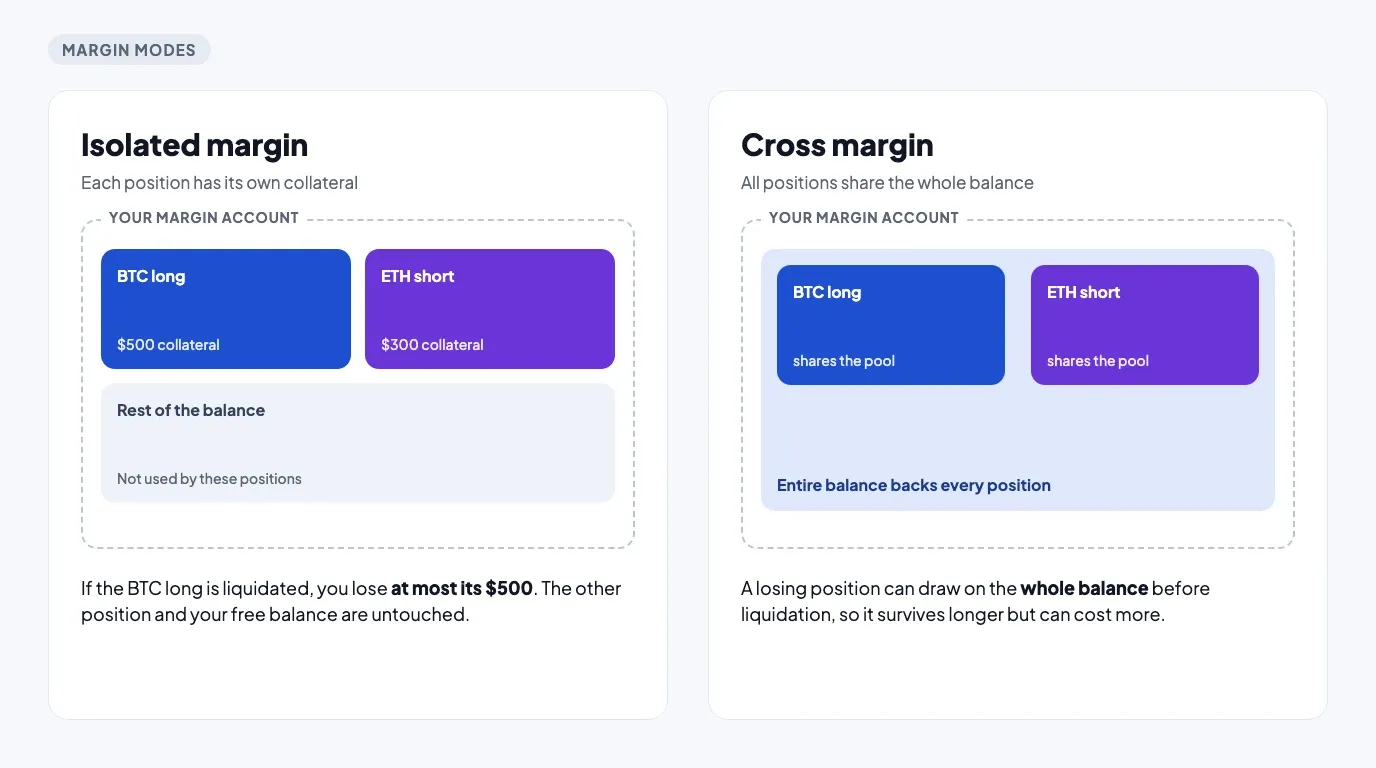
| Isolated margin | Cross margin | |
|---|---|---|
| Collateral | Set aside per position | The whole margin balance is shared |
| Maximum loss on liquidation | The collateral assigned to that position | Can reach the whole margin balance |
| Liquidation distance | Closer, since less collateral backs the position | Further, since the full balance backs it |
| Best for | Single trades with a defined risk | Several positions that hedge each other, managed actively |
For most traders, and especially beginners, isolated margin is the safer default: a bad trade cannot drain the rest of the account.
Margin Trading vs Futures Trading
| Margin trading | Futures and perpetual contracts | |
|---|---|---|
| What you trade | Real coins on the spot market | Contracts that track the price |
| Borrowing | You borrow funds or coins and repay them | No loan; you post margin for the contract |
| Ongoing cost | Interest on the borrowed amount | Funding payments on perpetuals, which can be paid or received |
| Typical leverage | Lower, often 3x to 10x | Higher, often up to 100x or more |
| Ownership | You hold the coins on a long | You do not own the coins |
Some traders prefer spot margin for longer leveraged longs because they hold real coins, while futures are more common for short-term trading and shorting. The difference also shows up in market structure:
Few #Bitcoin traders understand this:
Willy Woo (@woonomic) July 6, 2024
If you want to long BTC with leverage. DON'T buy futures, buy spot BTC with margin.
EXPLAINER
(1) Buying futures can be fulfilled by any counter trader who has USD collateral, together you are minting new synthetic BTC to the supply which…
What Margin Trading Costs
- Interest: charged on the borrowed amount, usually every hour, at a rate that changes with demand for each coin. For example, at 0.002% an hour, $4,000 of debt costs about $1.92 a day, or around $58 over a month. Rates vary widely by exchange and asset.
- Trading fees: the normal maker and taker fees on the full position size, not just your own capital.
- Liquidation fees: many exchanges charge an extra fee when they liquidate a position.
Risks of Crypto Margin Trading
- Losses grow with leverage. At 5x, a 10% move against you costs half of your capital.
- Fast liquidations. Crypto can move 10% in hours, and liquidation cascades can push prices through many traders' thresholds at once.
- Costs while you wait. Interest keeps running even when the price goes nowhere.
- Cross margin exposure. One losing position can pull down the whole margin balance.
- Exchange and regional rules. Margin trading is restricted or unavailable in some countries, and each exchange sets its own leverage limits and thresholds.
See where other traders' liquidations cluster with a liquidation map.
How to Start Margin Trading Crypto
- Check availability. Confirm your exchange offers margin trading in your country and read its leverage limits, interest rates and liquidation threshold.
- Open a margin account and transfer collateral. Most exchanges keep margin balances separate from your spot wallet.
- Choose isolated or cross margin. Start with isolated margin and low leverage.
- Borrow and place the trade. Many exchanges borrow automatically when you place a margin order.
- Set a stop loss before the liquidation price. Your stop should close the trade at a loss you accept, well before the exchange would liquidate it.
- Repay the loan. Closing the position repays the borrowed funds and interest; check that no debt is left open.

How to Manage Risk With Margin
- Risk a fixed share per trade. Many traders risk 1% to 2% of their account per trade and size the position from the stop distance, not from the maximum leverage. See how to calculate position size.
- Keep leverage low. Lower leverage moves the liquidation price further away and gives the trade room. See how leverage affects risk and return.
- Know your liquidation price. Check it before you enter and after any change to the position.
- React to margin calls early. Reduce the position or add collateral before the threshold, not at it. See managing leverage and margin calls.
- Watch the interest. Close or reduce positions that have stalled rather than paying to hold them.
Leveraged Trading With Altrady
Altrady supports spot and futures trading on your connected exchanges; spot margin borrowing itself is set up on the exchange. For leveraged trades, Altrady helps with the parts that decide how much you can lose: set the stop loss and take profits in the same order as the entry, size the position from the amount you are willing to lose with the risk/reward calculator, track open positions and PnL across exchanges, and practise leveraged setups on a paper trading account before using real funds.

Frequently Asked Questions
What is margin trading in crypto?
Margin trading in crypto is borrowing funds from an exchange to buy or short a cryptocurrency on the spot market, using your deposit as collateral. It increases the size of your position, so both gains and losses are multiplied, and you pay interest on the loan.
How does crypto margin trading work?
You deposit collateral, borrow funds from the exchange and open a larger position. The exchange tracks your margin level, the value of your assets compared with your debt, and liquidates the position if it falls to its threshold. When you close the trade, the loan and interest are repaid.
What is the difference between isolated and cross margin?
With isolated margin, each position has its own collateral and a liquidation loses at most that amount. With cross margin, your whole margin balance backs every position, which delays liquidation but can cost the entire balance.
Is margin trading the same as futures trading?
No. Margin trading borrows funds to trade real coins on the spot market and charges interest, while futures and perpetual contracts track the price without a loan, use funding payments instead, and usually allow higher leverage.
Can you lose more than you invest with margin trading?
On most crypto exchanges, liquidation closes the position before your debt exceeds your collateral, so with isolated margin the loss is usually limited to that position's collateral. With cross margin it can reach your whole margin balance, and in very fast markets fees and slippage can make losses larger than expected.
How much does margin trading cost?
You pay interest on the borrowed amount, usually charged hourly, plus normal trading fees on the full position and sometimes a liquidation fee. Rates vary by exchange and coin, so check them before opening a position.
Is margin trading good for beginners?
Margin trading is risky for beginners because leverage multiplies losses and liquidations can happen quickly. If you try it, use isolated margin, low leverage, a stop loss before the liquidation price, and practise on paper first.